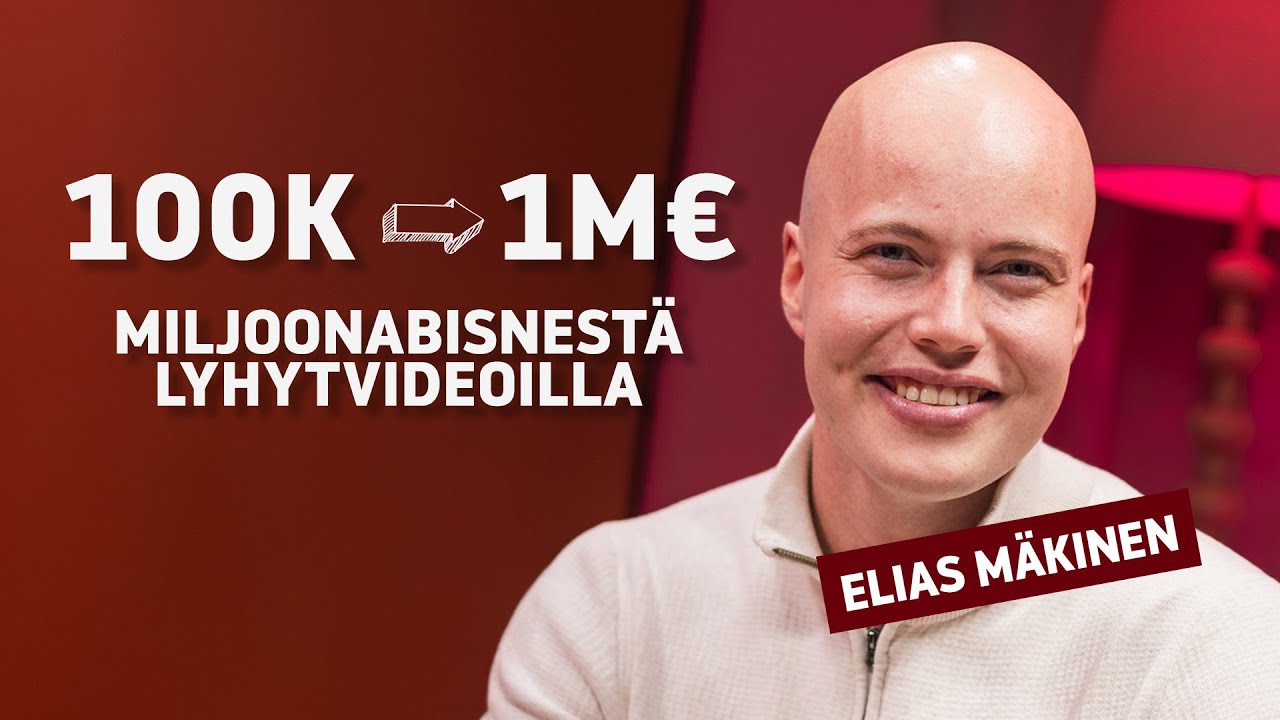
In April 2026, I gave a talk at MarkkinointiKollektiivi's FMCG afternoon on how FMCG brands should show up on social media. In this post, I've pulled together the key points from the keynote, and you can watch the full presentation (in Finnish) in the video above.
What this article covers
- The three biggest social media pitfalls I see at almost every FMCG brand
- Why they happen, and why the same mistakes repeat year after year
- A practical model that lets even a small team publish hundreds of videos a year
- Examples from Putaan Pulla and Panda, where the model has delivered both followers and direct sales
The biggest social media pitfalls for FMCG brands
At Höyrymedia, we make more than 200 short-form videos a month for different brands, and I've published around 600 videos featuring myself. The more videos we've made, the more clearly I've seen the same three problems crop up in FMCG brands' social media content almost every time.
Pitfall one: TV ads on social media. The brand has paid for a €50,000 production, catering included, and it has produced a great TV ad. Then the thinking goes: since the big production is already done, let's roll something out on social media too. The result is hyper-polished, TV-style advertising that, honestly, nobody watches for long on social media. Social media is where people want to see interesting content, not a sales pitch.
Pitfall two: no common thread. A product launch comes along, five influencers are hired and they all get the same brief: “make a video about this”. The result looks like a patchwork quilt, because everyone does it their own way and nobody has a view of how the brand should look on social media as a whole. Influencers are a great addition, of course, but your content can't be built around them. I prefer brands to have no more than three content pillars that all their content is created within. For example, viral content, behind-the-scenes content and a little advertising on the side. That way, everything hangs together.
Pitfall three: wanting to sell straight away. Every video ends with a call to “buy it in store now” or “try our new product”. A sales message gets forced into every clip. And that's exactly why social media doesn't bring in sales.
Why does this happen?
From my conversations with marketing decision-makers, there are usually three reasons behind it.
First, a small team and limited resources. Marketing budgets haven't gone up; if anything, they're being cut. Teams have to get more done with fewer people. In Finland, a marketing team of more than two is already a big one. Add the need to produce social media content constantly, and the equation becomes impossible. Not because of the team's skills, but because a hundred video posts a year simply can't come from the same resources that used to deliver a couple of big campaigns a year.
Second, the wrong metrics. Very often I notice that views are the main thing being measured. A video is said to have had 2 million views: good money went to Mark Zuckerberg and the video took off. But when you look closer, the average watch time turns out to be just 1.2 seconds.
In my view, a much better metric is watch time: how long people actually stay with your content. If you have, say, a two-minute video with 300,000 views and 60,000 people have watched it to the end, that's far more valuable than 2 million views where people swiped to the next video after one second.

Third, nobody really owns the content. Social media gets done when there's time. The work is reactive, and nobody on the team wakes up in the morning thinking, “how can I turn this into the most interesting and relevant content possible, content that resonates on social media?”. This is often the result of a lack of resources.
What can you do about it?
Three practical fixes that I've found work.
1. Maximum impact, minimum effort. You don't need to create hyper-personalised content for every channel. We all have our own favourite channels: for some it's YouTube, for others TikTok. The same interesting content resonates whatever the channel (LinkedIn excepted). And there's no harm in having good content on every channel. How many brands can really afford not to publish good content on a particular channel? Publishing is, after all, the cheapest part of marketing.
2. Share the same content across several channels. I often hear: “We can't put this TikTok content on Instagram, the audiences are so different.” Yes, you can. As long as you're putting out a few pieces of content every week, it's worth publishing them on every channel. The great thing about short-form video is that you don't need a separate square image for Instagram, a vertical one for Stories and a landscape video for your website: one short-form video works on every channel, your website included. It's impossible to say in advance which channel will work best for you.
3. Think social first. This is a big shift in thinking. Don't start from “let's make a €50,000 TV campaign and roll it out on social media”. A better model is to test what works on social media, scale it up into a bigger paid campaign and finally, say, onto TV. If I were into harness racing, I'd say: “put your money on the winning horse”.
A new way to create content
In practice, the model looks like this:
- 8–16 videos a month, filmed over one or two shoot days
- Distribution on 4 channels: Facebook, Instagram, TikTok, YouTube
- = 32–64 video posts a month
- = 384–768 video posts a year
A package like this costs around €50,000–100,000 a year.
Compare that with a single TV ad costing €50,000–100,000. The commercial impact of this approach is in a completely different league.
Viral short-form videos are also a bit like “lottery tickets”: not every ticket can win, even if you do everything “exactly right”. That's why it's important to create lots of chances to win.
How do I know this works?
Putaan Pulla: sales up 10% in a year
For Putaan Pulla, we've made simple, low-key content filmed on a phone: 2–3 videos a week, with the same videos on every channel and no channel-specific versions. Partners such as retailers and store buyers keep praising the videos. Putaan Pulla has even been able to expand and hire new staff in a shrinking market.
The content mainly revolves around three themes: stories from the owner family, humour and the products (without a sales angle). Surprisingly, the content that doesn't try to sell is what sells the most. Alongside the focused themes, the videos have a core cast of three on-screen talent. That keeps a clear common thread running through the work.
Panda: 0 → 70,000 followers, Finland's most-followed candy brand on TikTok
We've been creating content for Panda for three years, and in that time the account has grown from zero to 70,000 followers. Even though the content talks about the products a lot, the context is instantly clear: even if you only see one second of a video, you know straight away that it's Panda. Logos on clothing, the shop setting, a recognisable brand look. There are engaging elements too: giveaways are built into the content (“if this video gets 5,000 likes, we'll run a giveaway”) instead of a standard half-hearted giveaway or trying to force chocolate down the viewer's throat.
Power: 360 content on every channel
Power ran the Power X campaign, in which viewers tried to guess the code to a mystery briefcase to win a cash prize. The same campaign ran in stores, on the website, on social media and on TV. It's a good example of how multichannel marketing should be done and how videos can be versioned for different channels. Versioning doesn't mean cutting a vertical version of the TV ad: the social videos are made as a production of their own.
Mäksä's social media content checklist
If I had to sum it all up in three points, they'd be these:
- Make fewer ads and more interesting content. People don't want to see ads. They skip them the moment it's clear it's an advert.
- Watch time drives more sales than views. How long people stay with your content is the most important metric on social media.
- Make sure someone has real ownership of your social media: someone who wakes up in the morning thinking about how to make the brand's content as interesting as possible.
Let's start your short-form video journey!
If you'd like to go through what this model would look like for your brand, book a free 30-minute call. We'll look at how you could:
- increase sales
- make recruitment easier
- make your marketing more effective
- improve your brand and employer image